
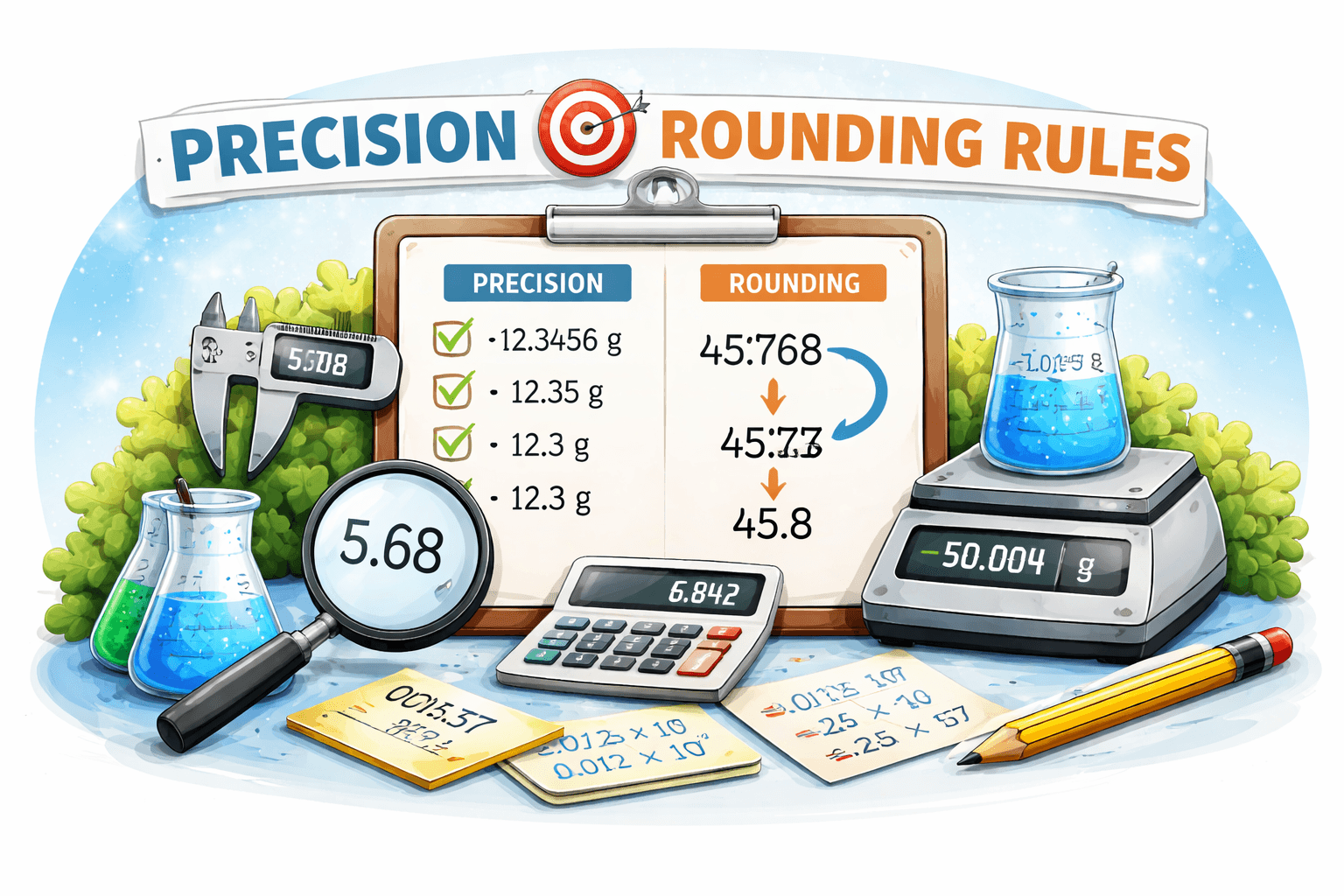
Precision and rounding rules are essential concepts in measurement and calculations in unit conversion. Whether you’re working in science, engineering, finance, or everyday conversions, understanding how to handle numbers correctly ensures accurate and reliable results.
Even small rounding errors can lead to significant differences, especially when dealing with large datasets or precise measurements.
What Is Precision?
Precision refers to the level of detail or exactness in a measurement. It indicates how close repeated measurements are to each other. Precision becomes especially important when working across different unit systems like Imperial or metric system.
For example:
- 5.1 kg → low precision
- 5.123 kg → higher precision
Higher precision means more detailed and consistent measurements.
What Is Rounding?
Rounding is the process of simplifying a number to make it easier to use while maintaining reasonable accuracy. This is particularly useful when simplifying results from unit conversions.
For example:
- 5.678 → 5.68 (rounded to 2 decimal places)
- 1234 → 1230 (rounded to nearest ten)
Rounding helps make numbers more practical for calculations and communication.
Why Precision and Rounding Matter
1. Accuracy in Calculations
Accurate rounding ensures results are not misleading.
2. Scientific Reliability
Precision is critical in experiments and technical fields. Many scientific calculations depend on standardized units.
3. Consistency in Conversions
When converting units, proper rounding avoids errors.
👉 Try accurate conversions using our Unitconversion Tools.
Basic Rounding Rules
Rule 1: Look at the Next Digit
- If the next digit is 5 or more → round up
- If it is less than 5 → round down
Examples:
- 2.345 → 2.35
- 2.342 → 2.34
Rule 2: Rounding to Decimal Places
| Number | Rounded (2 decimal places) |
|---|---|
| 4.567 | 4.57 |
| 3.123 | 3.12 |
Rule 3: Rounding Whole Numbers
| Number | Rounded |
|---|---|
| 1567 | 1570 (nearest 10) |
| 1567 | 1600 (nearest 100) |
These rounding principles are widely used when solving equations using dimensional analysis.
Significant Figures Explained
Significant figures (or sig figs) represent the meaningful digits in a number. They are essential in scientific measurements and data reporting.
Examples:
- 0.0045 → 2 significant figures
- 123.45 → 5 significant figures
Rules for Significant Figures:
- Non-zero digits are always significant
- Leading zeros are not significant
- Trailing zeros may or may not be significant depending on context
Precision in Measurements
Different tools provide different levels of precision:
- Ruler → less precise
- Digital scale → more precise
- Scientific instruments → highly precise
👉 Understand how measurement systems affect precision in our metric system guide.
Rounding in Unit Conversion
When converting units, rounding should be applied carefully:
Example:
1 inch = 2.54 cm
If converting:
10 inches = 25.4 cm
👉 You may round to:
- 25.4 cm (precise)
- 25 cm (approximate)
Use rounding based on the required level of accuracy.
👉 Try it yourself with our length converter.
Common Mistakes to Avoid
- ❌ Rounding too early in calculations
- ❌ Ignoring significant figures
- ❌ Using inconsistent precision
- ❌ Over-rounding important values
Incorrect rounding in conversions can lead to real-world problems. Check out some of the infamous mistakes in history.
Real-World Applications
Science & Engineering
Precise values are critical for experiments and designs.
Finance
Rounding affects calculations like interest and pricing. Hence, currency conversions depend on proper rounding.
Everyday Life
Used in cooking, measurements, and quick estimates.
Conclusion
Precision and rounding rules are fundamental for accurate measurements and calculations. By understanding how to apply these rules correctly, you can avoid errors, improve consistency, and ensure reliable results in both professional and everyday applications.
Mastering these concepts is especially important when working with unit conversions and scientific data.
👉 Try It Yourself using our Unitconversion Tools.
🔗 Related Guides
📌 Key Takeaways
- Precision refers to the level of detail and exactness in a measurement.
- Rounding rules help simplify numbers while maintaining reasonable accuracy.
- Correct rounding depends on the digit following the rounding place value.
- Understanding precision and rounding improves clarity in calculations, reporting, and scientific measurements.