
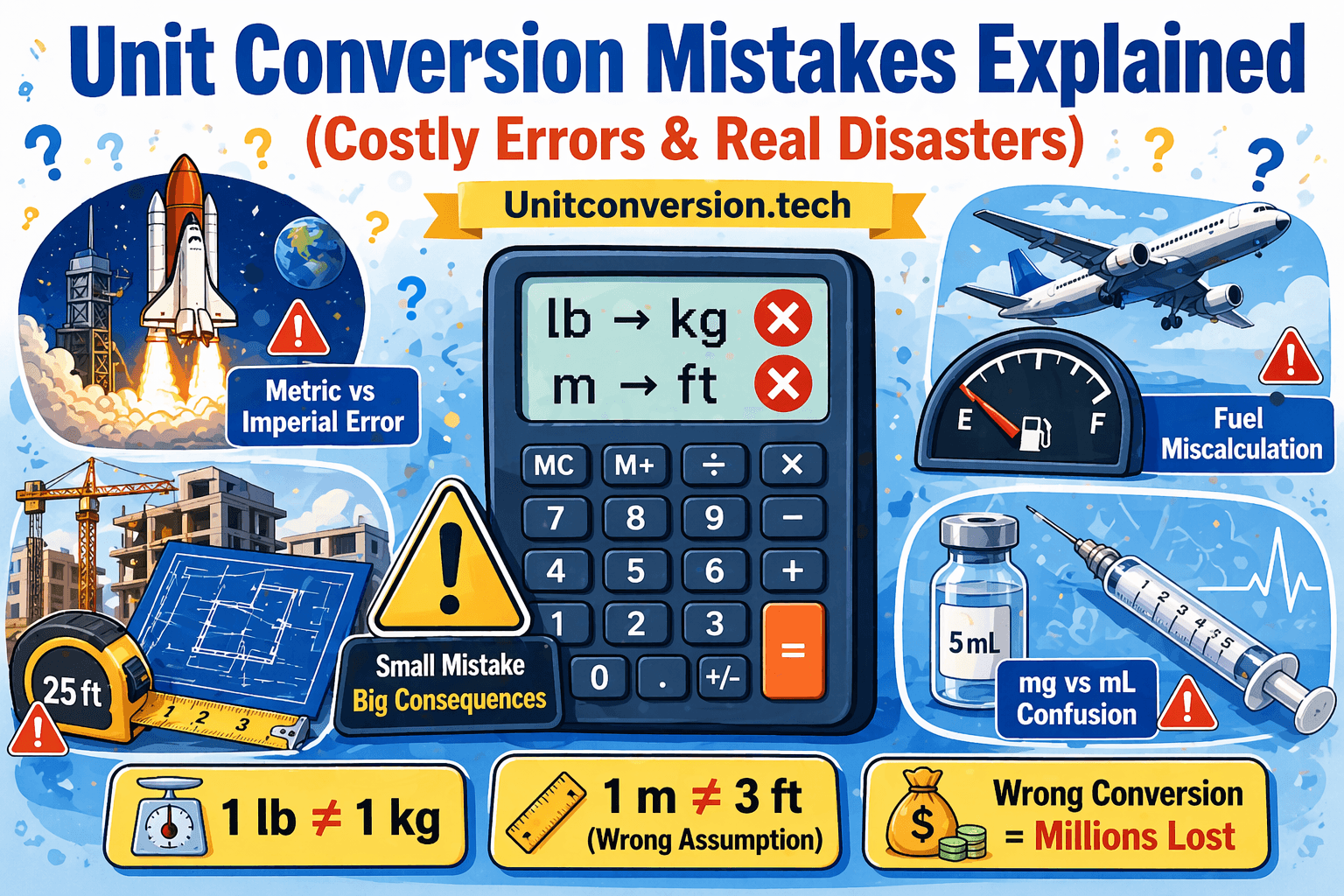
Unit conversions may seem like small calculations but in the real world, they can lead to massive failures and financial losses. From space missions to aviation disasters, simple mistakes in converting units have cost millions (and sometimes billions) of dollars. In this guide, you’ll explore some of the most famous unit conversion mistakes, understand why they happened, and to avoid such errors, it’s important to understand what unit conversion is? and how different systems work.
🌍 Why Unit Conversion Mistakes Matter
At first glance, converting units like meters to feet or kilograms to pounds feels simple. But in industries like engineering, aerospace, medicine, and construction where unit conversion in engineering is critical, even a tiny error can have serious consequences.
A small mismatch in units can lead to:
- Incorrect calculations
- System failures
- Safety risks
- Huge financial losses
The problem is not the math; it’s inconsistency and miscommunication.
🚨 1. NASA’s Mars Climate Orbiter (1999)
One of the most famous and costly mistakes in history. This incident is documented by NASA as a classic example of unit mismatch failure.
❌ What went wrong in Mars Climate Orbiter:
- One team used imperial units (pound-force)
- Another team used metric units (newtons)
This mismatch caused incorrect navigation calculations. Learn more about the difference between imperial & metric units.
💥 Result:
- The spacecraft entered Mars’ atmosphere at the wrong angle
- It burned up and was destroyed
💸 Cost:
~$125 million lost
👉 A simple unit conversion mistake led to the loss of an entire space mission.
✈️ 2. The Gimli Glider Incident (1983)
A real aviation emergency caused by a fuel calculation error on Air Canada Flight 143 on 23rd July 1983.
❌ What went wrong in this Gimli Glider incident:
- Fuel was measured in kilograms, but calculations were done assuming pounds (quick guide on Kg to pounds)
- The aircraft was loaded with far less fuel than needed
💥 Result:
- The plane ran out of fuel mid-air
- Pilots had to glide and land without engines
💸 Cost:
No lives lost but it became one of the most dangerous aviation incidents.
👉 Shows how unit confusion can risk human lives, not just money.
🏗️ 3. Construction & Engineering Errors
Many large-scale projects have faced issues due to unit mistakes.
❌ Common issues:
- Mixing feet and meters
- Confusing square feet vs square meters
- Incorrect material measurements
💥 Result:
- Structural problems
- Project delays
- Cost overruns
💸 Cost:
Often runs into millions in rework and delays.
👉 These mistakes are more common than you think.
⚕️ 4. Medical Dosage Errors
Unit mistakes in healthcare can be extremely dangerous.
❌ What goes wrong:
- Mixing mg (milligrams) and mcg (micrograms)
- Incorrect dosage conversions
These are examples of how precision and rounding rules become critical in real-world scenarios.
💥 Result:
- Overdose or underdose
- Serious health risks
👉 In this case, the cost is not money, it’s patient safety.
🧠 Why Do These Mistakes Happen?
Most unit conversion errors come down to a few key issues:
1. Mixing Different Systems
Imperial vs metric confusion is the biggest cause.
2. Poor Communication
Different teams using different standards without clarity.
3. Lack of Double-Checking
Small assumptions go unnoticed.
4. Human Error
Manual calculations increase risk. However, understanding dimensional analysis can significantly reduce such risks.
✅ How to Avoid Costly Conversion Mistakes
Here are practical ways to prevent these errors:
✔ Use One Standard System
Stick to either metric or imperial, not both.
✔ Always Label Units Clearly
Never assume, always write the unit.
✔ Double-Check Calculations
Especially in critical applications.
✔ Use Reliable Tools
Automated converters reduce human error.
✔ Train Teams Properly
Ensure everyone follows the same measurement standards.
📊 Real Lesson: Small Errors, Big Consequences
What these examples teach us is simple:
👉 Unit conversion is not just basic math, its critical real-world skill, explained in more detail at unit conversion basics.
A tiny mistake in units can:
- Destroy a spacecraft
- Endanger lives
- Delay projects
- Waste millions of dollars
📌 Final Thoughts
Unit conversions are part of everyday life, but their importance goes far beyond classrooms.
Whether you’re:
- A student
- A professional
- Or just learning
Understanding unit conversion properly can help you:
✔ Avoid costly mistakes
✔ Improve accuracy
✔ Build real-world skills
If history has taught us anything, it’s this: 👉 Always check your units.
🔗 Related Guides
📌 Key Takeaways
- Unit conversion mistakes have caused real-world failures costing millions of dollars.
- One of the most famous examples is the Mars Climate Orbiter loss due to metric vs imperial confusion.
- Small conversion errors in engineering, aviation, and construction can lead to massive consequences.
- Always double-check units when working with formulas, especially in technical fields.
- Using consistent measurement systems reduces the risk of costly errors.
- Automated tools and standardized systems help prevent conversion mistakes.
- Understanding unit conversions is essential not just for exams, but for real-world accuracy and safety.