
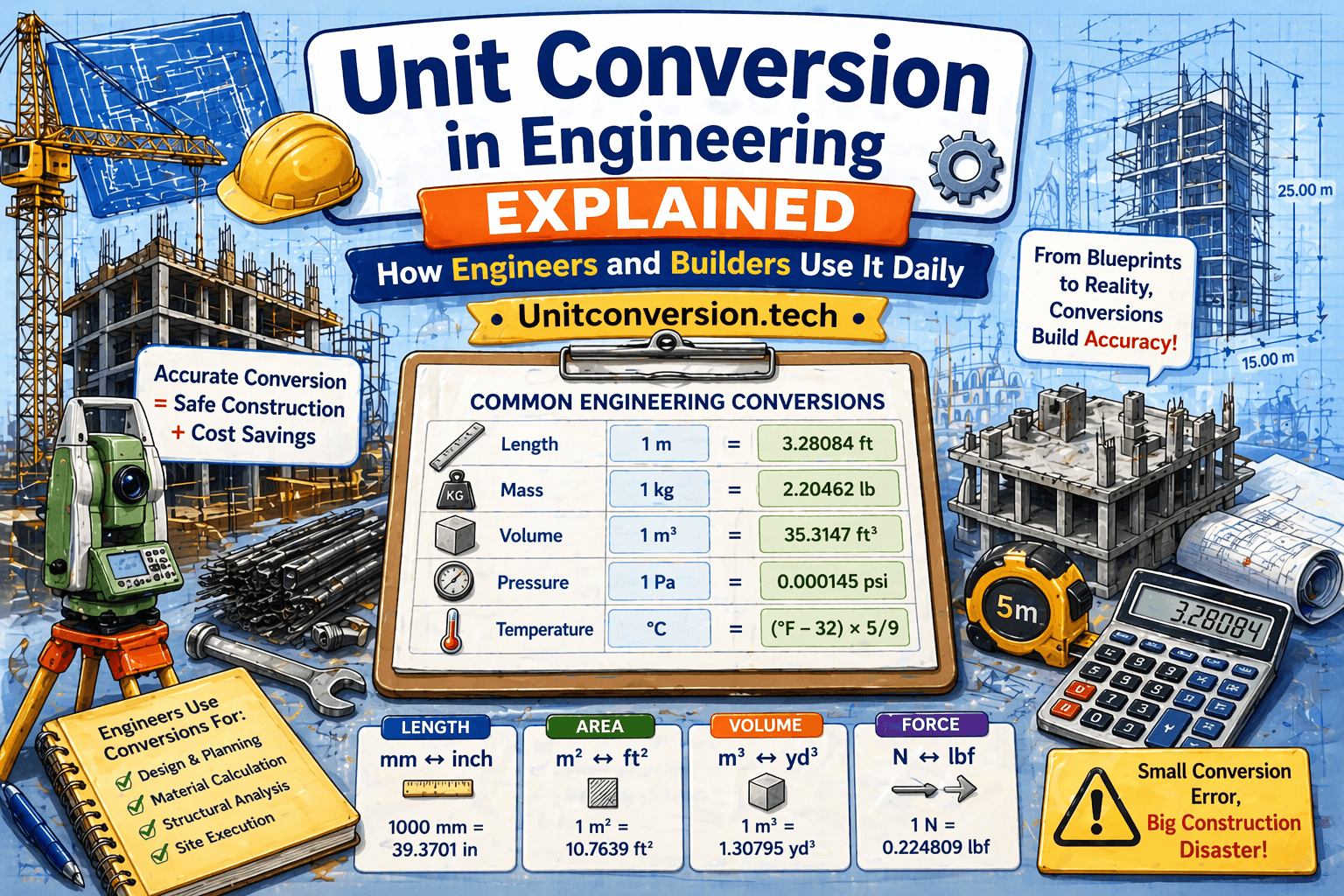
In engineering and construction, accuracy is everything. A small mistake in measurement can lead to structural issues, project delays, or even safety risks. That’s why unit conversion in engineering is a daily part of work. From designing buildings to calculating materials, professionals constantly switch between different units to ensure precision and consistency which is why understanding what unit conversion is becomes essential.
📐 Why Unit Conversion Is Critical in Engineering
Engineering projects involve multiple variables and Standards are often guided by organizations like ISO (International Organization for Standardization).
- Length
- Area
- Volume
- Weight
- Pressure
Each of these can be expressed in different units depending on the measurement system being used.
👉 Without proper unit conversion:
- Calculations become inaccurate
- Designs may fail
- Costs can increase significantly
For quick reference, see our Engineering Conversion Reference Table.
🌍 Working with Different Measurement Systems
In global projects, teams often deal with both:
- Metric system → meters, kilograms, liters
- Imperial system → feet, pounds, gallons
😕 The challenge:
Different teams may use different standards.
👉 Engineers must convert units to ensure:
- Consistent calculations
- Clear communication
- Accurate results
🏗️ Real-Life Applications of Unit Conversion
Unit conversion is used at every stage of construction and engineering.
📏 1. Design and Blueprints
Architects and engineers create designs using precise measurements.
Example:
- Converting feet to meters for international projects
- Adjusting dimensions based on local standards
👉 Even a small conversion error can affect the entire structure.
🧱 2. Material Estimation
Builders calculate how much material is needed.
Example:
- Converting cubic meters to cubic feet
- Calculating weight of materials in tons vs kilograms
👉 Incorrect conversions can lead to:
- Material shortages
- Excess costs
⚙️ 3. Machinery and Equipment
Equipment specifications often use different units.
Example:
- Power in horsepower vs kilowatts
- Pressure in PSI vs Pascals
👉 Engineers must convert these correctly to ensure compatibility.
🚧 4. Construction Execution
On-site work requires quick and accurate decisions.
Example:
- Measuring distances
- Adjusting layouts
- Ensuring alignment
👉 Builders rely on correct unit conversion to maintain accuracy.
⚠️ What Happens When Conversions Go Wrong
Even small errors can have serious consequences.
❌ Possible issues:
- Misaligned structures
- Weak foundations
- Project delays
- Increased costs
👉 In extreme cases, mistakes can lead to structural failure.
🧠 Why Conversion Errors Occur
1. Mixing Systems
Using metric and imperial together without clarity.
2. Manual Calculations
Higher chance of human error.
3. Poor Communication
Teams not aligned on measurement standards.
4. Rounding Errors
Small approximations leading to bigger issues.
✅ How Professionals Avoid Conversion Mistakes
✔ Use Standardized Systems
Most projects stick to one system (usually metric).
✔ Use Digital Tools
Software and calculators reduce manual errors.
✔ Double-Check Calculations
Critical measurements are always verified.
✔ Clear Documentation
All units are clearly labeled in plans and reports.
✔ Training and Experience
Professionals are trained to handle unit conversions accurately.
📊 Why Unit Conversion Skills Matter
For engineers and builders, unit conversion is not optional; it’s essential.
It helps:
✔ Ensure structural safety
✔ Maintain accuracy
✔ Improve efficiency
✔ Reduce costs
📌 Final Thoughts
Behind every building, bridge, or machine is a series of precise calculations and unit conversion plays a key role in all of them. What may seem like a simple mathematical step is actually a critical part of real-world problem-solving.
👉 In engineering and construction, accuracy in units means safety in reality.
🔗 Related Guides
📌 Key Takeaways
- Unit conversion is a daily requirement in engineering and construction projects.
- Engineers often work with both metric and imperial systems, especially in global projects.
- Accurate conversion ensures proper design, material estimation, and execution.
- Even small conversion errors can lead to costly delays or structural issues.
- Common applications include blueprints, material calculations, and machinery specifications.
- Using digital tools and standardized systems helps reduce conversion mistakes.
- Clear communication and proper documentation are essential to avoid unit confusion.