
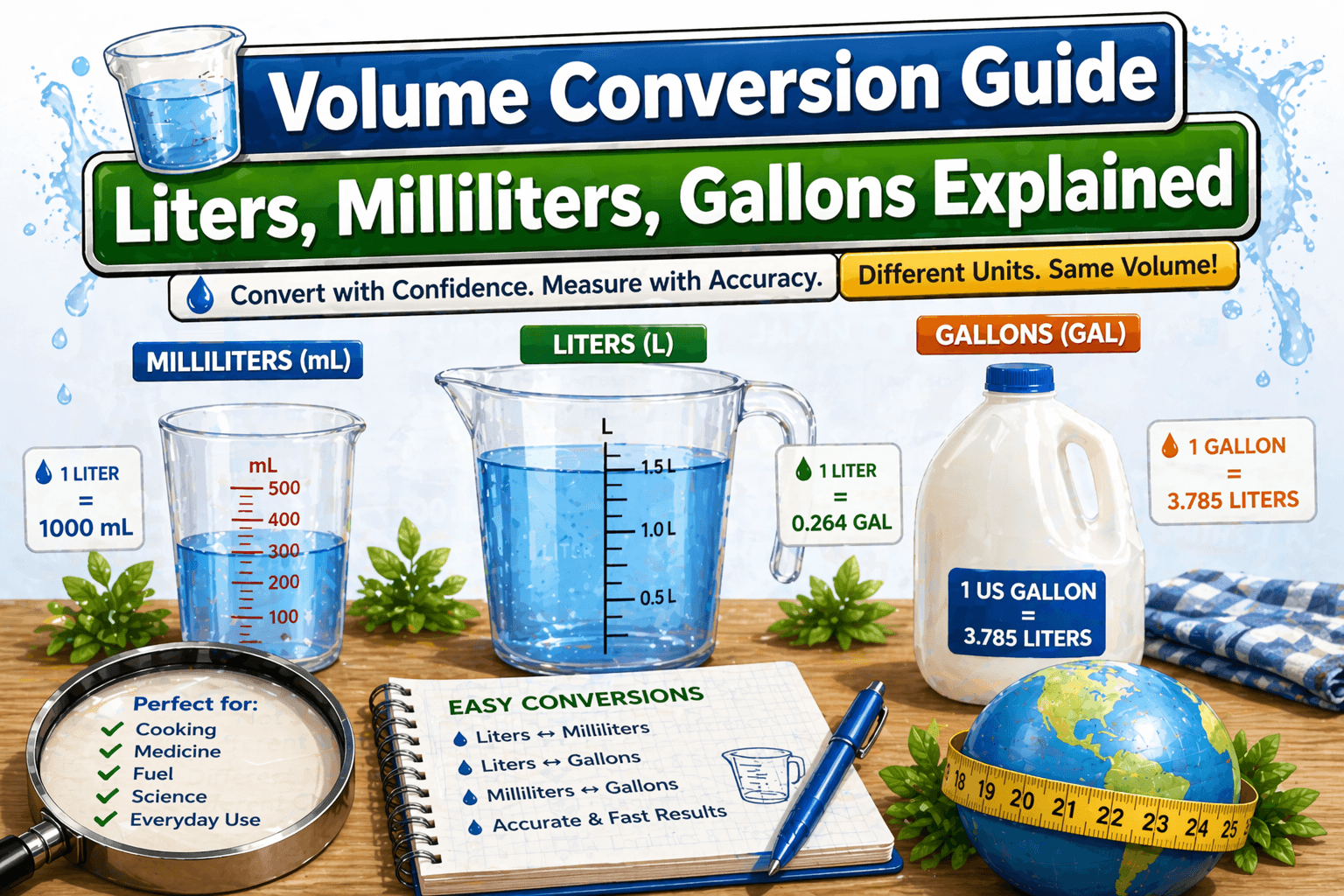
Volume conversion is an important concept used in everyday life, from cooking and medicine to fuel measurement and industrial applications. Different regions use different units such as liters, milliliters, and gallons, which can make understanding quantities confusing. Learning how to convert between these units helps ensure accuracy and better decision-making in daily tasks.
🧪 What is Volume?
Volume refers to the amount of space a liquid or substance occupies.
It is commonly measured in:
- Liters (L) → Standard metric unit
- Milliliters (mL) → Smaller metric unit
- Gallons (gal) → Common in the US and UK
👉 These units are used depending on the quantity and region.
🔢 Key Volume Relationships
Understanding a few basic relationships makes conversion easy:
- 1 liter = 1000 milliliters
- 1 US gallon ≈ 3.785 liters
- 1 liter ≈ 0.264 gallons
👉 These are the most commonly used conversion values.
🧠 Understanding the Metric System (L & mL)
The metric system is simple because it is based on multiples of 10.
- 1 L = 1000 mL
- 500 mL = 0.5 L
- 250 mL = 0.25 L
👉 This makes conversions straightforward – just move the decimal. Learn how this base-10 system works in our metric system guide.
🌍 Gallons vs Liters (Why It Gets Confusing)
The main confusion comes from different gallon definitions. According to the National Institute of Standards and Technology (NIST), measurement standards such as the US gallon and imperial gallon are officially defined and differ in volume:
- US gallon → 3.785 liters
- Imperial (UK) gallon → 4.546 liters
👉 That means: 1 UK gallon is larger than 1 US gallon. Check actual number difference when comparing gallon to liters.
This difference is important in:
- Fuel measurements
- International trade
- Travel
🍳 Real-Life Examples
Volume conversion is used in many everyday situations:
- Cooking: 500 mL = 0.5 L
- Beverages: 2 L bottle = 2000 mL
- Fuel: 1 gallon ≈ 3.785 L
👉 These examples show how volume units are applied in daily life.
⚡ Quick Conversion Methods
Here are simple ways to convert quickly:
- Liters → milliliters: Multiply by 1000
- Milliliters → liters: Divide by 1000
- Liters → gallons: Multiply by 0.264
- Gallons → liters: Multiply by 3.785
👉 These shortcuts are useful for fast calculations. Learn the fundamentals in our guide titled: What is Unit Conversion?
⚠️ Common Mistakes to Avoid
- Confusing US and UK gallons
- Forgetting that 1 L = 1000 mL
- Mixing volume with weight (e.g., liters vs kilograms)
👉 Always check the unit system before converting and avoid calculation errors using precision & rounding rules guide.
🧴 Where Volume Conversion is Used
Volume conversion is essential in:
- Cooking and recipes
- Medicine (liquid dosage)
- Fuel measurement
- Packaging and manufacturing
- Scientific experiments
👉 It plays a key role in both daily life and professional fields.
📊 Quick Reference Values
Here are some commonly used conversions:
- 100 mL → 0.1 L
- 250 mL → 0.25 L
- 500 mL → 0.5 L
- 1 L → 1000 mL
- 1 gallon → ~3.785 L
📊 Volume Conversion Table (Quick Reference)
| Milliliters (mL) | Liters (L) | US Gallons (gal) |
|---|---|---|
| 100 mL | 0.1 L | 0.026 gal |
| 250 mL | 0.25 L | 0.066 gal |
| 500 mL | 0.5 L | 0.132 gal |
| 1000 mL | 1 L | 0.264 gal |
| 2000 mL | 2 L | 0.528 gal |
👉 These values are helpful to remember for quick use.
🎯 Why Volume Conversion Matters
Understanding volume conversion helps you:
- Follow recipes accurately
- Measure liquids correctly
- Compare products globally
- Avoid costly mistakes
👉 It’s a simple but essential everyday skill. Also, explore real-life confusion in product sizes across different countries.
✅ Conclusion
Volume conversion is a practical and widely used skill that helps bridge different measurement systems. By understanding key relationships and using simple conversion methods, you can confidently work with liters, milliliters, and gallons in both daily life and professional situations.
📌 Key Takeaways
- Volume measures the space occupied by a liquid or substance.
- 1 liter equals 1000 milliliters.
- 1 US gallon is approximately 3.785 liters.
- Metric conversions are simple because they use multiples of 10.
- Volume conversion is widely used in cooking, medicine, and industry.