
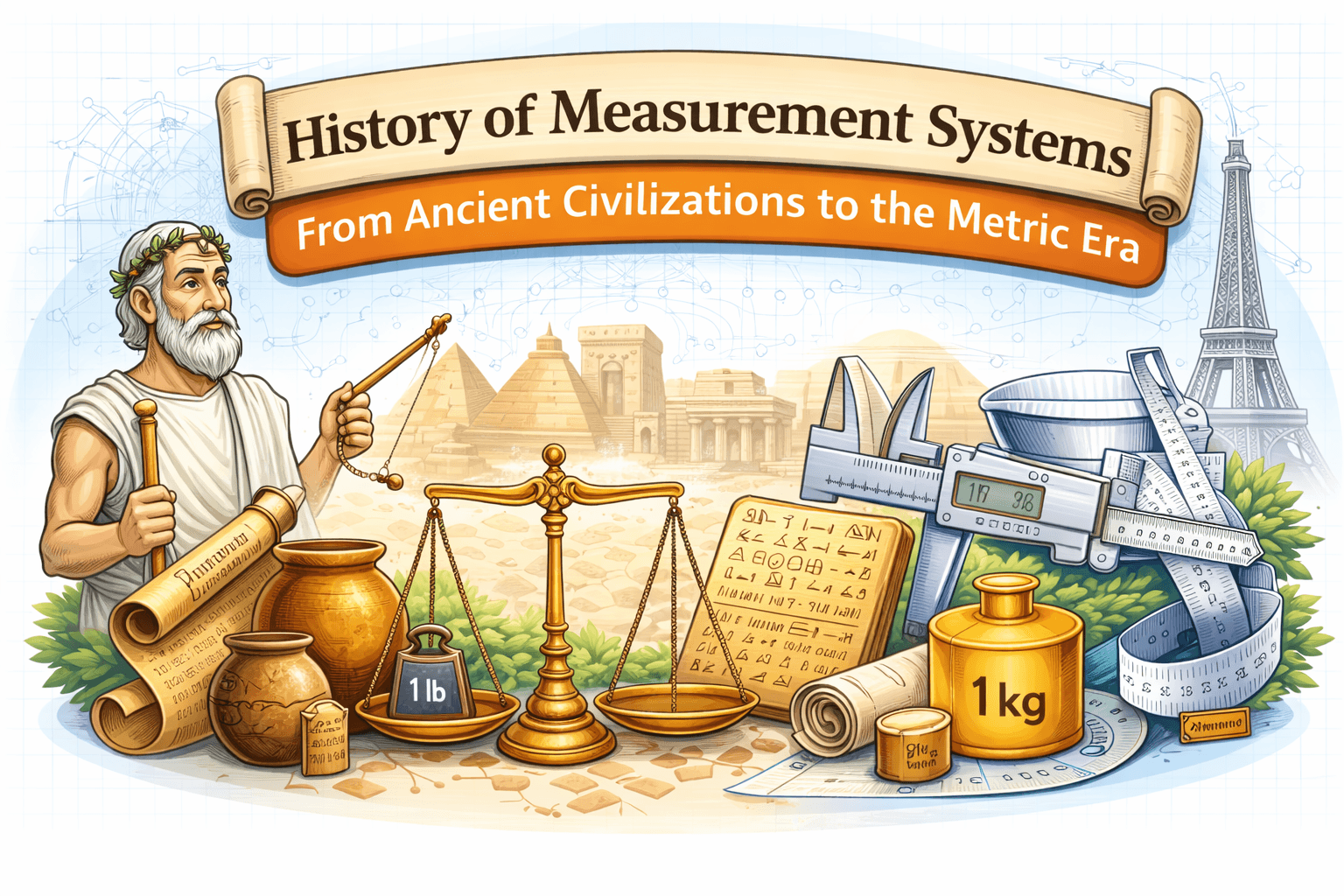
Measurement is fundamental to human civilization. From building pyramids to launching satellites, societies have relied on standardized measurement systems to measure length, weight, time, and volume. But history of measurement systems was not always universal. Throughout history, different civilizations developed their own units based on culture, trade, geography, and practical needs. Over time, these systems evolved into the globally standardized units we use today.
🏺 Early Measurement in Ancient Civilizations
The earliest measurement systems were based on the human body. These early systems lacked consistency, which made comparisons difficult across regions.
Common ancient units included:
- Cubit (length of the forearm)
- Foot
- Hand
- Finger
Ancient Egypt
The Egyptians used the royal cubit (approximately 52 cm) to construct pyramids and temples. They created physical measuring rods to maintain consistency.
Mesopotamia
Babylonians developed base-60 numerical systems, which still influence how we measure time (60 seconds, 60 minutes).
Ancient India
Ancient Indian texts mention standardized units for trade and construction, including measurements for length, weight, and capacity.
⚖️ Medieval and Regional Systems
During the Middle Ages, measurement systems varied widely across regions. Each kingdom or territory often had its own:
- Pound
- Yard
- Gallon
- Acre
This caused confusion in trade and commerce. This inconsistency is one of the main reasons unit conversion knowledge and use became necessary.
For example, a “pound” in one region might not equal a pound in another. Lack of uniformity slowed economic growth and created disputes.
The Development of the Imperial System
In 1824, Britain formally established the Imperial System to standardize measurements across the empire.
It defined units such as:
- Yard (length)
- Pound (mass)
- Gallon (volume)
The imperial system later influenced the United States, which still uses a variation known as the US customary system. These measurement systems are still compared today when discussing global measurement differences.
The Birth of the Metric System
The French Revolution marked a turning point in measurement history.
In 1799, France introduced the metric system, based on:
- Decimal structure
- Scientific constants
- Universal standardization (Recognized by International Bureau of Weights and Measures)
Key features:
- Meter for length
- Kilogram for mass
- Liter for volume
The goal was simplicity, fairness, and international consistency. You can read here more about Understanding the Metric System.
🌍 Global Adoption of the Metric System
Over time, the metric system gained international acceptance.
Reasons for adoption:
- Easier calculations (base-10 system)
- Scientific precision
- Simplified global trade
- Standardization across industries
Today, most countries use the metric system as their official measurement standard. However, not all countries transitioned fully, leading to a mixed global system.
🔬 The International System of Units (SI)
In 1960, the metric system evolved into the International System of Units (SI).
The SI system defined seven base units:
- Meter (length)
- Kilogram (mass)
- Second (time)
- Ampere (electric current)
- Kelvin (temperature)
- Mole (amount of substance)
- Candela (luminous intensity)
These units form the foundation for modern scientific measurement. And are critical for ensuring precision and avoiding calculation errors.
📊 Why Standardization Was Necessary
Before standardization:
- Trade disputes were common
- Scientific collaboration was difficult
- Engineering errors increased
- Conversions were inconsistent
A global standard improved:
- International commerce
- Scientific research
- Industrial development
- Safety and precision
⚖️ Metric vs Imperial Today
While most of the world uses metric units, the United States continues to rely heavily on imperial units in daily life.
However, even in the US:
- Science uses metric
- Medicine uses metric
- Military operations use metric
Metric system dominance is nearly universal in scientific fields. But usage of other measurement systems by some countries created confusion in everyday scenarios.
🚀 Measurement in the Modern Era
Modern measurement has moved beyond physical reference objects.
Today, units are defined using:
- Speed of light
- Atomic transitions
- Quantum standards
This ensures extreme precision in:
- Aerospace engineering
- Global positioning systems
- Medical technology
- Electronics manufacturing
Measurement continues to evolve as technology advances. Read more about the importance of precision and accuracy.
🧠 The Importance of Measurement Systems
Measurement systems shape:
- Engineering accuracy (Guide on unit conversion in engineering)
- Scientific discovery
- Economic stability
- Global communication
Without standardized measurement, modern civilization would not function efficiently.
🏁 Conclusion
The history of measurement systems reflects humanity’s journey toward precision, fairness, and global cooperation. From ancient cubits to modern SI units, measurement has evolved to meet the demands of science, trade, and technology. Today’s standardized systems ensure consistency across borders, industries, and disciplines making global collaboration possible.
🔗 Related Guides
📌 Key Takeaways
- Early measurement systems were based on human body parts and local standards.
- Different regions historically used inconsistent units, causing trade challenges.
- The metric system was introduced in France in 1799 to create universal standards.
- The International System of Units (SI) was formalized in 1960.
- Standardized measurement systems are essential for science, engineering, and global trade.