
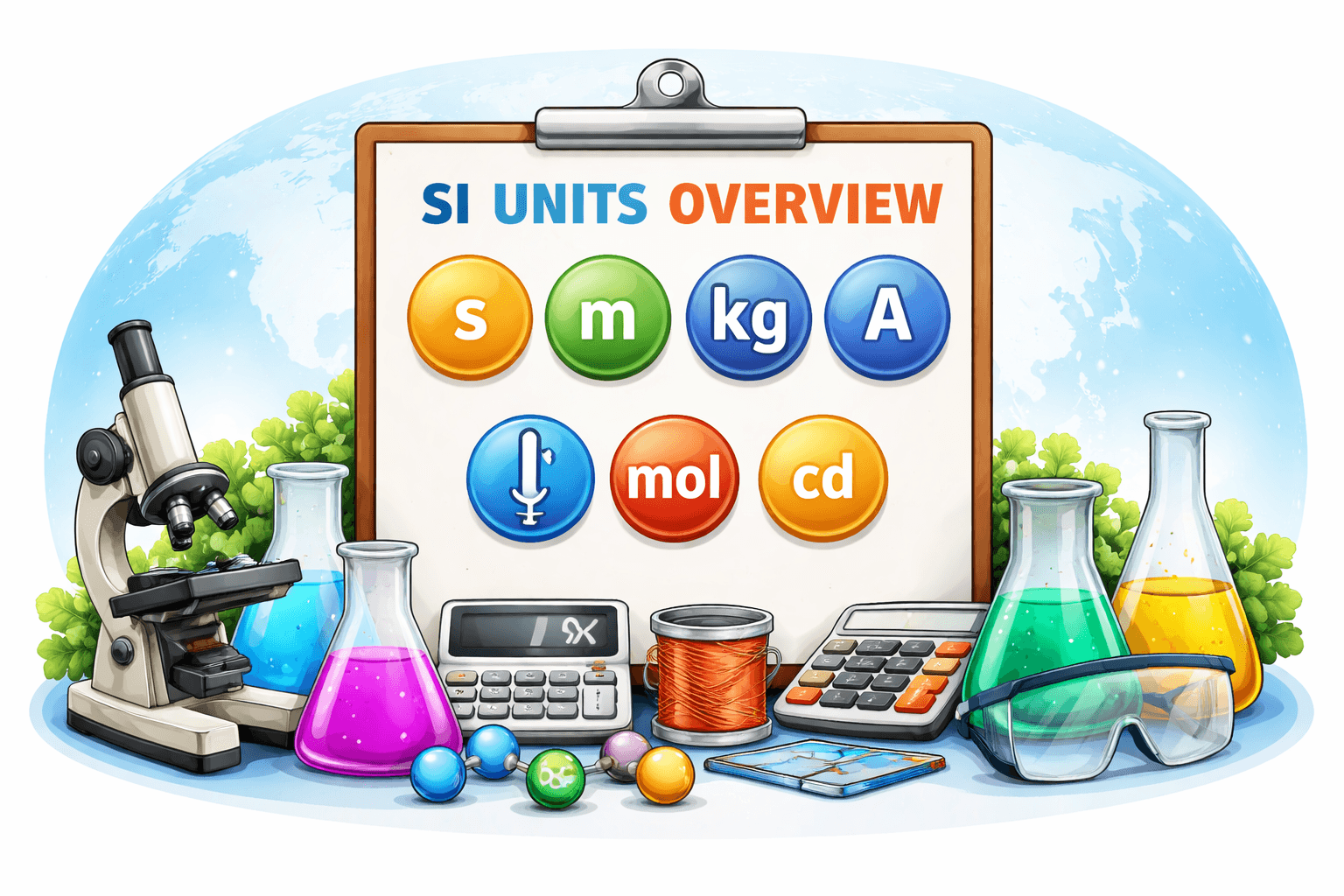
The International System of Units (SI) is the globally accepted standard for measurement used in science, engineering, industry, and everyday applications. It provides a consistent framework for measuring physical quantities such as length, mass, time, and temperature using unit conversion.
Understanding SI units is essential for accurate calculations, reliable data comparison, and global communication across different fields.
What Are SI Units?
SI units are a standardized system of measurement based on the metric system. They are designed to ensure consistency and precision in measurements worldwide.
The SI system is built on seven base units, from which all other units are derived.
The 7 SI Base Units
| Quantity | Unit Name | Symbol |
|---|---|---|
| Length | meter | m |
| Mass | kilogram | kg |
| Time | second | s |
| Electric Current | ampere | A |
| Temperature | kelvin | K |
| Amount of Substance | mole | mol |
| Luminous Intensity | candela | cd |
These base units form the foundation of all scientific measurements and further used to build more complex measurements through derived units and scientific formulas.
Derived SI Units
Derived units are created by combining base units.
Examples include:
- Velocity → meters per second (m/s)
- Force → newton (N)
- Energy → joule (J)
- Pressure → pascal (Pa)
These units are essential in physics, engineering, and real-world calculations. And to solve complex unit relationships, engineers often use dimensional analysis.
Why SI Units Are Important
1. Global Standardization
SI units are used worldwide, ensuring consistency in scientific research and international communication.
2. Accuracy and Precision
Proper use of SI units also reduces errors caused by incorrect rounding.
3. Easy Integration with Metric System
SI units follow the same base-10 structure as the metric system, making conversions simple.
👉 Learn more about this in our metric system guide.
SI Units vs Other Measurement Systems
Unlike systems such as the imperial system, SI units are:
- Standardized globally
- Based on decimal relationships
- Widely used in science and technology
👉 Compare systems in detail: imperial vs metric system
SI Prefixes (Scaling Units)
SI units use prefixes to represent large and small values.
| Prefix | Symbol | Value |
|---|---|---|
| kilo | k | 1000 |
| mega | M | 1,000,000 |
| giga | G | 1,000,000,000 |
| milli | m | 0.001 |
| micro | µ | 0.000001 |
| nano | n | 0.000000001 |
These prefixes simplify working with very large or very small quantities. And are used daily in real-world conversions like:
Real-World Applications
Science & Research
Learn how unit conversion impacts science discoveries.
Engineering
Used in design, calculations, and system modeling. See how engineers use conversions in their daily work life.
Healthcare
Medical measurements rely on SI units for accuracy. Even small unit mistakes can be dangerous.
Everyday Life
Temperature (Celsius), weight (kg), and distance (meters) are commonly used. And you also encounter these in daily situations while traveling and cooking.
Practical Conversion Examples
- 1 kilometer = 1000 meters
- 1 milligram = 0.001 grams
- 1 megabyte = 1,000,000 bytes
👉 Try conversions using our data storage and length converter.
Conclusion
The International System of Units (SI) provides a universal and reliable framework for measurement across the world. Its standardized structure, precision, and compatibility with the metric system make it essential for science, engineering, and everyday use.
By understanding SI units, you avoid common conversion mistakes and gain the ability to perform accurate measurements, communicate clearly across disciplines, and apply conversions effectively in real-world scenarios.
👉 Try It Yourself
Use our UnitConversion Tools to explore SI-based conversions instantly.
🔗 Related Guides
📌 Key Takeaways
- The International System of Units (SI) is the modern form of the metric system used worldwide.
- SI is built around seven base units including meter, kilogram, second, ampere, kelvin, mole, and candela.
- All other SI units are derived from these base units using consistent mathematical relationships.
- SI units ensure global standardization in science, engineering, trade, and education.