
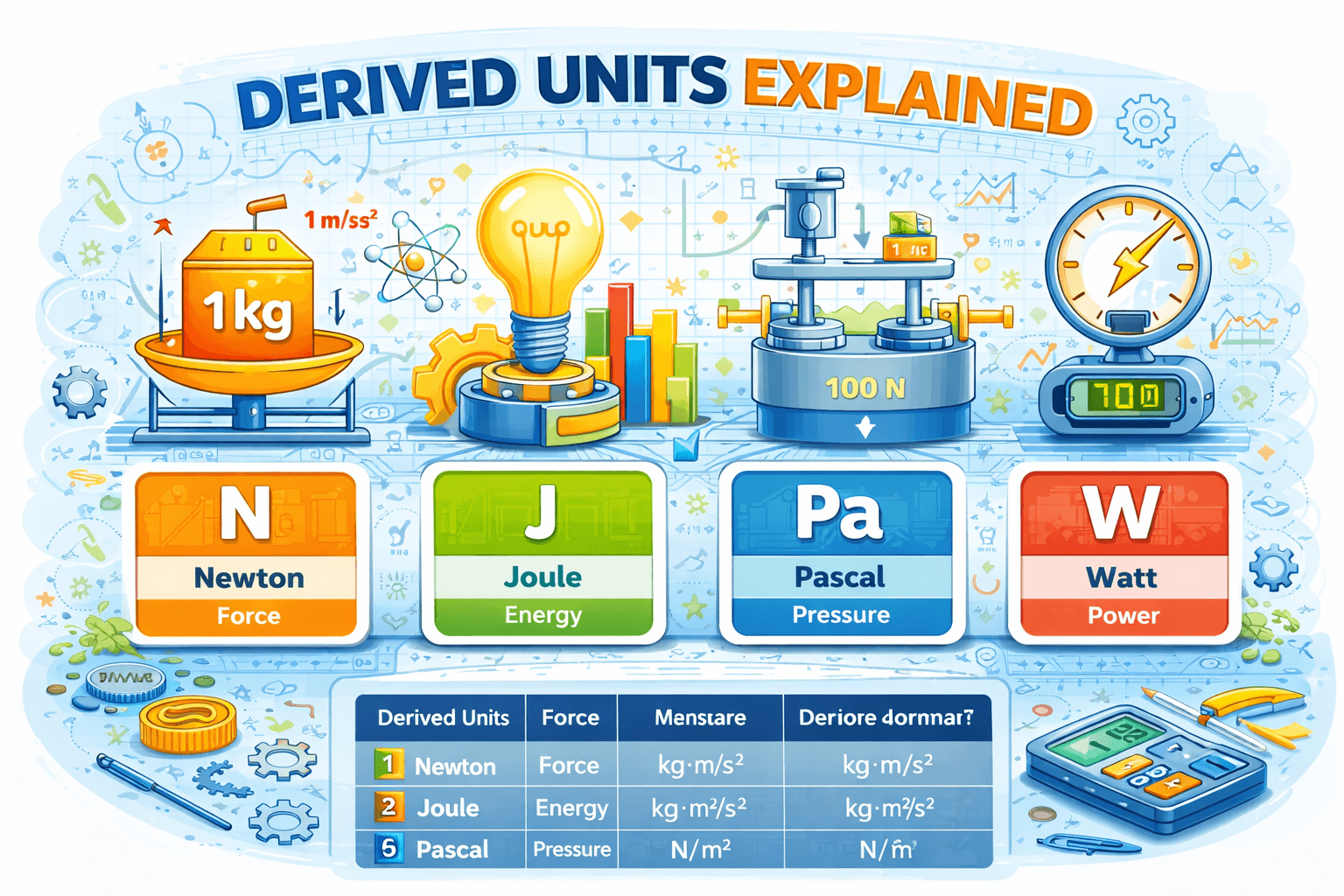
Measurement systems are built on fundamental units such as meters, kilograms, and seconds. However, many real-world quantities like force, energy, and pressure require combinations of these base units.
These combined units are called derived units. Understanding derived units helps explain how physics, engineering, and technical calculations work in real applications.
📘 What Are Derived Units?
Derived units are measurement units formed by combining two or more SI base units through multiplication or division. This process is closely related to dimensional relationships in physics. They describe more complex physical quantities such as:
- Force
- Energy
- Pressure
- Power
- Electric charge
- Frequency
For example:
- Speed = meters per second (m/s)
- Acceleration = meters per second squared (m/s²)
These are derived because they are calculated from base units. Understanding this also helps in performing accurate unit conversions.
🔧 Common SI Derived Units Explained
These derived units are part of the globally standardized SI system. Below are some of the most important derived units used in science and engineering.
⚖️ Newton (N) – Unit of Force
The Newton (N) measures force.
Formula:
1 Newton = 1 kg × m/s²
This means a force of one Newton is required to accelerate a 1-kilogram object by 1 meter per second squared.
Real-World Use:
- Engineering design (🔧Engineering Conversion Reference Table)
- Structural load calculations
- Physics experiments
⚡ Joule (J) – Unit of Energy
The Joule (J) measures energy or work.
Formula:
1 Joule = 1 Newton × 1 meter
Or
1 J = 1 kg × m²/s²
Real-World Use:
- Mechanical work
- Electrical energy
- Heat calculations
Most energy conversions are standardized using Joules in the SI system. These calculations often rely on correct dimensional relationships.
🌡 Pascal (Pa) – Unit of Pressure
The Pascal (Pa) measures pressure.
Formula:
1 Pascal = 1 Newton per square meter (N/m²)
This means pressure equals force distributed over an area.
Real-World Use:
- Hydraulic systems
- Weather measurements
- Industrial machinery
Pressure converters rely heavily on Pascals and calculations are widely used in engineering and construction.
⚙️ Watt (W) – Unit of Power
The Watt (W) measures power – the rate at which energy is transferred.
Formula:
1 Watt = 1 Joule per second (J/s)
Real-World Use:
- Electrical appliances
- Mechanical engines
- Energy consumption tracking
🔌 Coulomb (C) – Unit of Electric Charge
The Coulomb (C) measures electric charge.
Formula:
1 Coulomb = 1 Ampere × 1 second
Real-World Use:
- Electrical engineering
- Circuit calculations
📊 Derived Units Summary Table
| Derived Unit | Symbol | Measures | Derived From |
|---|---|---|---|
| Newton | N | Force | kg·m/s² |
| Joule | J | Energy | kg·m²/s² |
| Pascal | Pa | Pressure | N/m² |
| Watt | W | Power | J/s |
| Coulomb | C | Electric Charge | A·s |
🔎 Why Derived Units Matter
Derived units are essential because:
- They simplify complex formulas
- They standardize scientific communication
- They prevent confusion across countries
- They allow engineers to design safely
- They connect theory to real-world application
Without derived units, every calculation would require writing full base-unit expressions.
🧠 How Derived Units Support Unit Conversion
When converting units:
- Pressure tools rely on Pascals
- Energy converters rely on Joules
- Force conversions depend on Newtons
- Power calculations depend on Watts
Understanding derived units improves:
- Accuracy
- Conversion consistency
- Technical confidence
⚠️ Common Mistakes with Derived Units
- Confusing Newton with kilogram
- Mixing Joules and Watts
- Forgetting area when calculating pressure
- Using inconsistent unit systems
Always ensure all base units match before performing calculations.
🏁 Conclusion
Derived units combine SI base units to measure real-world physical quantities like force, energy, pressure, and power. Units such as Newton, Joule, Pascal, and Watt form the backbone of engineering, physics, and industrial systems. Understanding derived units not only improves conceptual clarity but also strengthens your ability to perform accurate conversions and technical calculations.
🔗 Related Guides
📌 Key Takeaways
- Derived units are formed by combining two or more SI base units through multiplication or division.
- Common derived units include Newton (force), Joule (energy), Pascal (pressure), Watt (power), and Coulomb (electric charge).
- Derived units simplify complex scientific formulas and standardize technical communication.
- Understanding derived units improves accuracy in engineering calculations and unit conversions.
- Consistent use of SI units prevents errors in scientific and industrial applications.