
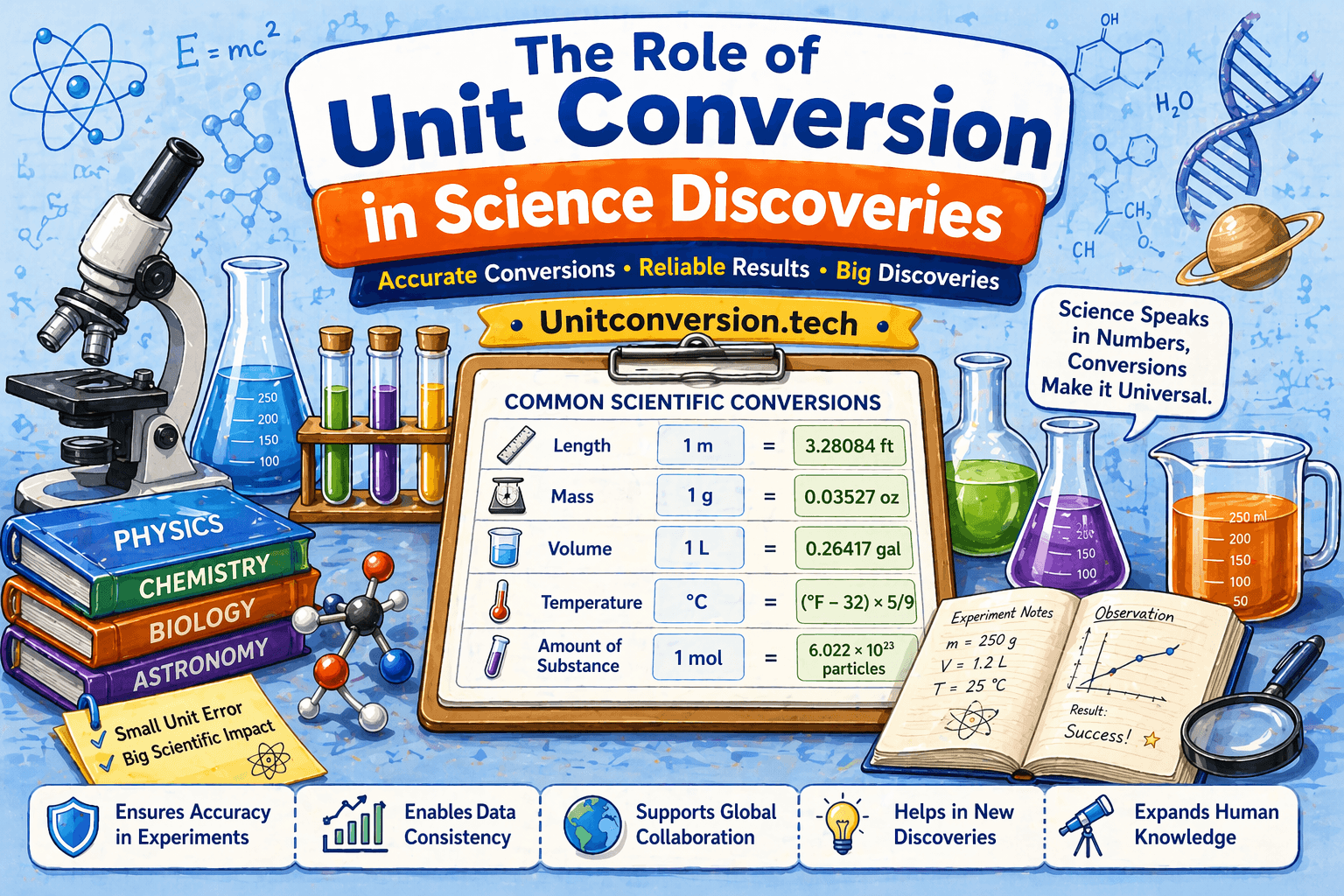
Scientific discoveries shape the world we live in from medicine and space exploration to climate science and engineering. But behind every major breakthrough lies something simple yet powerful: accurate measurement and unit conversion. Without proper unit conversion in science, even the most advanced scientific research can lead to errors, failed experiments, or costly mistakes. In this guide, you’ll learn how unit conversion plays a critical role in science, why it matters, and how it has influenced some of the most important discoveries in history.
🔬 Why Unit Conversion Matters in Science
Science is built on precision, consistency, and reproducibility. Researchers across the world must be able to understand, verify, and replicate each other’s work. This is only possible when measurements are standardized using globally accepted systems like the metric system.
Unit conversion helps scientists:
- Communicate results across different countries and systems
- Maintain consistency in experiments
- Avoid calculation errors
- Combine data from multiple sources
For example, a scientist in the U.S. might record temperature in Fahrenheit, while another in Europe uses Celsius. Without conversion, comparing results would be impossible.
🌍 The Importance of Standardized Units
To solve this problem, scientists rely on the International System of Units (SI). This system provides a universal language for measurement. It is maintained globally by organizations like the Bureau International des Poids et Mesures (BIPM).
Key SI units include:
- Meter (length)
- Kilogram (mass)
- Second (time)
- Kelvin (temperature)
Unit conversion allows scientists to move between systems when needed, ensuring global collaboration.
🚀 Real-Life Examples of Unit Conversion in Science
1. Space Exploration and NASA Errors
One of the most famous examples is the Mars Climate Orbiter mission in 1999. The spacecraft was lost because one team used imperial units (pounds-force) while another used metric units (newtons).
👉 Result: A $125 million mission failed due to a unit conversion mistake.
This highlights how even small conversion errors can have massive consequences.
2. Medicine and Drug Dosage
In healthcare and pharmaceutical research, unit conversion is critical.
Doctors and scientists regularly convert:
A small error in conversion can lead to incorrect dosages, which may be dangerous or even life-threatening.
3. Physics and Engineering Discoveries
In physics, equations often involve multiple units like velocity, force, energy, and more.
For example:
- Speed: meters per second (m/s) which is a type of derived unit.
- Force: newtons (N)
- Energy: joules (J)
Scientists must convert units correctly to apply formulas and validate results. Many discoveries in physics depend on precise conversions between these units.
4. Climate Science and Global Data
Climate researchers collect data from around the world:
- Temperature (Celsius, Kelvin)
- Rainfall (mm, inches)
- Wind speed (km/h, mph)
To analyze global patterns, all this data must be converted into consistent units. Without this step, climate models would be unreliable.
⚠️ Common Problems Without Unit Conversion
When unit conversion is ignored or done incorrectly, it can lead to:
- Experimental errors
- Misinterpretation of data
- Failed scientific models
- Financial losses
- Safety risks
👉 Even small mistakes like confusing centimeters with meters can drastically change results.
🧠 How Scientists Ensure Accuracy
Scientists use several methods to avoid conversion errors:
✔️ Standard Units (SI System)
Most scientific work is done using SI units to minimize confusion.
✔️ Conversion Tools & Software
Modern labs use software to automatically convert units and reduce human error.
✔️ Peer Review Process
Scientific research is reviewed by experts who check calculations, including unit consistency.
✔️ Dimensional Analysis
This method ensures that equations make sense by checking unit relationships. Read in detail on our guide on Dimensional analysis.
🔄 Unit Conversion in Everyday Science
Unit conversion isn’t limited to labs – it appears in everyday science applications:
- Cooking measurements (Grams ↔ Ounces)
- Fuel efficiency (Km/L ↔ Mpg)
- Weather reports (Celsius ↔ Fahrenheit)
- Fitness tracking (Kg ↔ Lbs)
These simple conversions are based on the same principles used in advanced scientific research.
💡 Why It Matters More Than You Think
Unit conversion may seem like a basic concept, but it is essential for:
- Scientific accuracy
- Global collaboration
- Technological innovation
- Safety in critical fields
Without it, modern science simply wouldn’t function.
📌 Final Thoughts
Every scientific breakthrough whether it’s landing a spacecraft on Mars or developing a life-saving drug depends on precise measurements and correct unit conversions. It’s not just about numbers; it’s about ensuring accuracy, reliability, and trust in science. The next time you convert units, remember you’re using the same principle that powers some of the world’s greatest discoveries.
🔗 Related Guides
📌 Key Takeaways
- Unit conversion is essential in science to ensure accurate and consistent measurements.
- Scientists use standardized systems like SI units to collaborate globally and avoid confusion.
- Even small unit conversion errors can lead to major failures, such as lost space missions.
- Fields like medicine, physics, and climate science rely heavily on precise unit conversions.
- Dimensional analysis helps scientists verify that equations and conversions are correct.
- Modern tools and software reduce human error in scientific unit conversions.
- Accurate unit conversion is critical for safety, reliability, and successful scientific discoveries.