
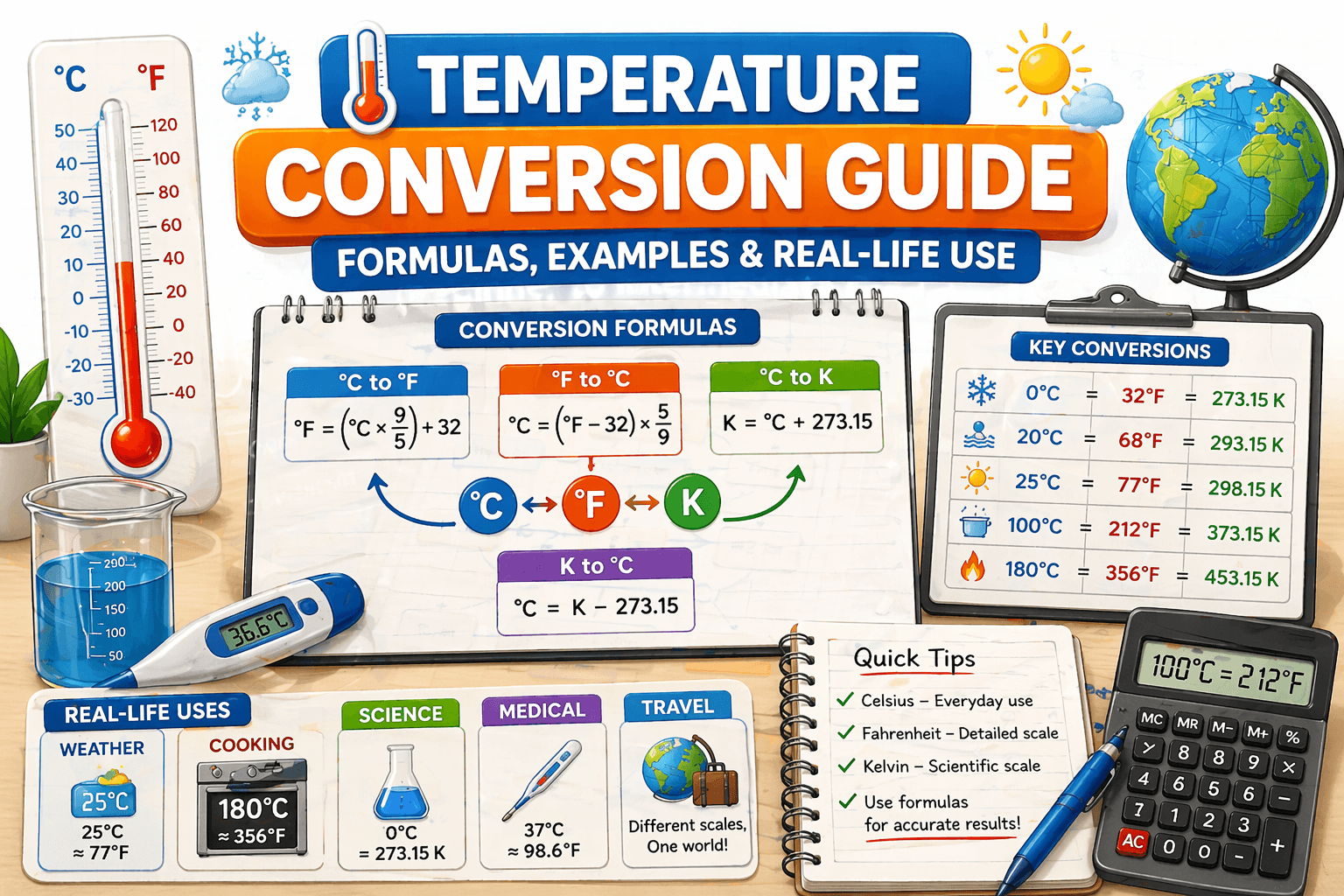
Temperature conversion is an essential concept used in daily life, science, and global communication. Different countries and industries use different temperature scales such as Celsius, Fahrenheit, and Kelvin. Understanding how to convert between these units helps you interpret weather, follow recipes, and work with scientific data accurately.
🌡️ Understanding Temperature Scales
There are three main temperature scales:
- Celsius (°C) → Used in most countries
- Fahrenheit (°F) → Used mainly in the United States
- Kelvin (K) → Used in scientific calculations
👉 These scales are part of globally standardized measurement systems. and each scale has different reference points which can avoid confusions across different countries:
- Water freezes at 0°C = 32°F = 273 K
- Water boils at 100°C = 212°F = 373 K
🔢 Temperature Conversion Formulas
Here are the key formulas you need:
Celsius to Fahrenheit
Fahrenheit to Celsius
Celsius to Kelvin
Kelvin to Celsius
👉 These formulas allow accurate conversions between all major scales and used in both scientific and everyday calculations.
🧠 Simple Understanding Trick
Instead of memorizing everything:
- Celsius → based on water (0 to 100 scale)
- Fahrenheit → more detailed scale (32 to 212)
- Kelvin → absolute scale (starts from zero energy)
👉 Think of Kelvin as a scientific version of Celsius. This understanding becomes even more important when working with precise calculations.
🌍 Real-Life Examples
Temperature conversion is used in many situations:
- Weather reports: 25°C ≈ 77°F
- Cooking: 180°C ≈ 356°F (oven temperature)
- Science: 0°C = 273.15 K
👉 These examples show how temperature conversion connects daily life with technical use. Temperature differences are one of the most common sources of confusion for travelers.
⚡ Quick Approximation Methods
For fast estimation:
- °C → °F: Multiply by 2 and add 30
- °F → °C: Subtract 30 and divide by 2
- 20°C → ~68°F (actual 68°F)
- 86°F → ~30°C
👉 Useful for quick thinking, but not exact. For critical applications, always rely on precise formulas instead of estimates.
🧪 Where Temperature Conversion Is Used
Temperature conversion plays an important role in:
- Weather forecasting
- Cooking and baking
- Medical measurements
- Scientific experiments
- Industrial processes
👉 Different fields prefer different scales depending on accuracy and context. These conversions are also important in engineering systems and design.
⚠️ Common Mistakes
- Forgetting to add/subtract 32 in formulas
- Confusing Kelvin with Celsius
- Using approximation when precision is needed
👉 Always use formulas for accurate results.
🎯 Why Temperature Conversion Matters
You’ll use this in:
- Weather understanding
- Cooking and baking
- Travel between countries
- Scientific calculations
🔍 Comparing the Scales
Each scale serves a purpose:
- Celsius → everyday use
- Fahrenheit → detailed weather variation
- Kelvin → scientific accuracy
👉 Knowing all three makes you more adaptable globally.
🌡️ Temperature Conversion Chart (Quick Reference)
Sometimes, instead of calculating every time, it’s easier to use a quick reference. Here are some commonly used temperature conversions:
- 0°C → 32°F
- 10°C → 50°F
- 20°C → 68°F
- 25°C → 77°F
- 30°C → 86°F
- 37°C → 98.6°F (body temperature)
- 100°C → 212°F
👉 These values are frequently used in daily life, so remembering a few of them can save time.
✅ Conclusion
Temperature conversion is a practical skill that connects everyday life with scientific understanding. It also highlights how different measurement systems are used around the world. By learning simple formulas and approximation methods, you can easily switch between Celsius, Fahrenheit, and Kelvin depending on the situation.
🔗 Related Guides
📌 Key Takeaways
- Celsius, Fahrenheit, and Kelvin are the main temperature scales.
- Use formulas to convert accurately between temperature units.
- Approximation methods help with quick mental conversions.
- Kelvin is mainly used in scientific calculations.
- Temperature conversion is useful in daily life, travel, and science.