
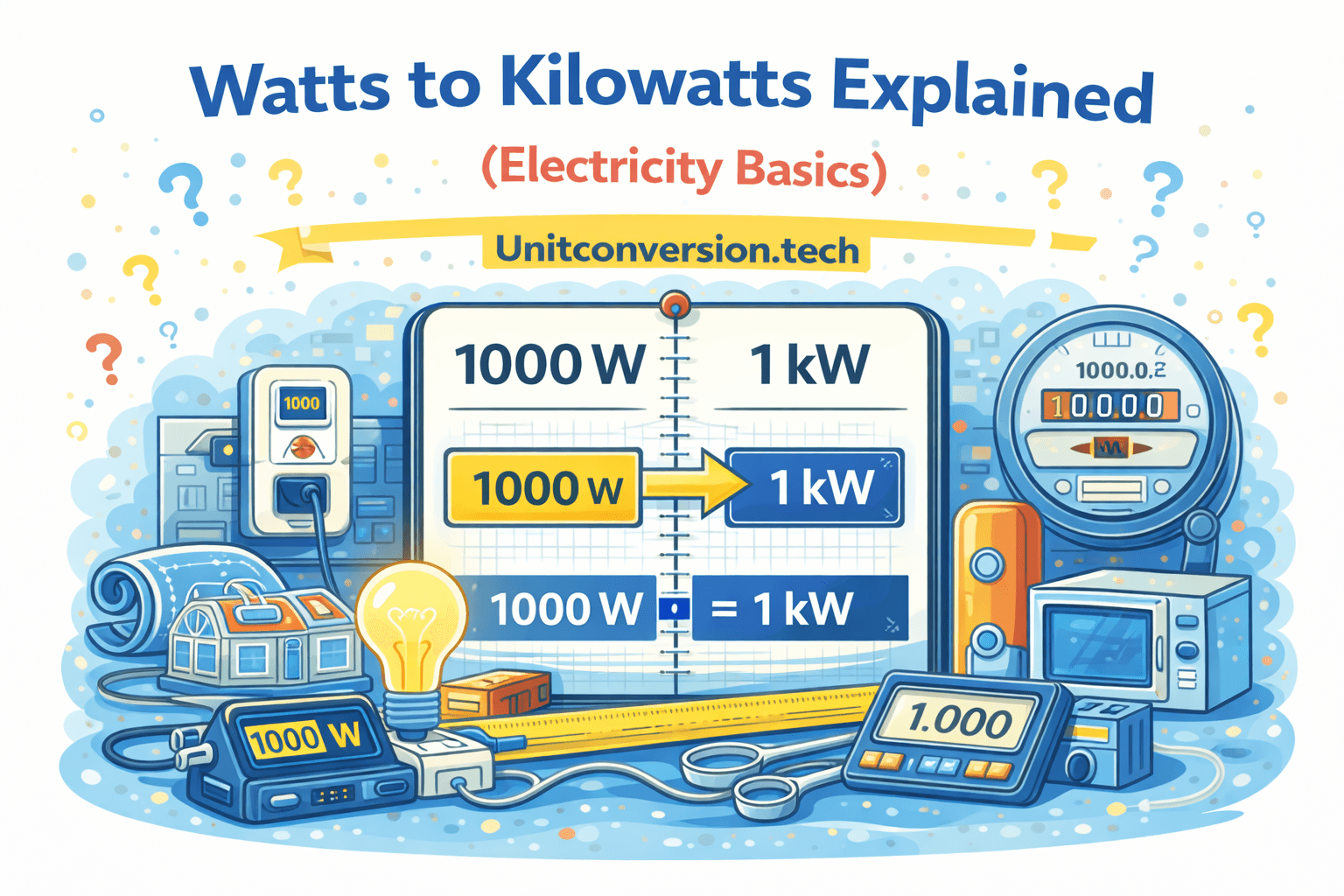
Watts to kilowatts is a common conversion used to understand electricity usage in homes and appliances. Since power consumption is often measured in watts (W) while electricity bills use kilowatts (kW), knowing how to convert between them helps you track energy usage and manage costs more effectively. Understanding how units scale up or down is part of a broader concept of measurement conversion.
💡 Start with Your Electricity Bill
Look at your electricity bill. You’ll see something like: Units consumed (kWh)
Now look at your appliances:
- Fan → 75 watts
- Bulb → 10 watts
- AC → 1500 watts
👉 Different units → same concept. That’s where watts to kilowatts comes in. This is similar to how other unit conversions work across different measurement systems.
🔌 What’s the Actual Difference?
- Watt (W) → small unit (used for appliances)
- Kilowatt (kW) → larger unit (used for total usage)
👉 The key relationship: 1 kilowatt = 1000 watts. This type of relationship between units is called a derived unit relationship in measurement systems.
🧠 Think in “Power Bundles” (Simple Idea)
Instead of math, think like this:
👉 1000 watts = 1 bundle (1 kW)
- 500 W = 0.5 kW
- 1500 W = 1.5 kW
👉 You’re just grouping watts into 1000. This grouping method is commonly used in metric-based systems to simplify calculations.
🏠 Real-Life Appliance Examples
Let’s connect this to your home:
- LED bulb: 10 W = 0.01 kW
- Ceiling fan: 75 W = 0.075 kW
- Microwave: 1000 W = 1 kW
- Air conditioner: 1500 W = 1.5 kW
👉 Now you can instantly understand how “heavy” an appliance is. These kinds of conversions are especially useful when comparing appliance efficiency (i.e. in engineering).
⚡ Quick Conversion Trick
👉 To convert watts → kilowatts:
Divide by 1000
- 2000 W → 2 kW
- 750 W → 0.75 kW
For accurate calculations, especially in technical scenarios, it’s important to consider precision and rounding rules.
💸 Why This Matters for Your Bill
Electricity is charged in kilowatt-hours (kWh)
- 1 kW appliance running for 1 hour = 1 unit
- 1000 W AC for 1 hour → 1 unit
- 500 W device for 2 hours → 1 unit
👉 This helps you estimate costs easily. Energy calculations like these are widely used in both household planning and industrial systems.
⚠️ Common Confusion
👉 Mixing kW and kWh ❌
- kW → power (how strong)
- kWh → energy (how much used over time)
👉 Your bill is based on kWh, not kW. This unit confusion is one of the most common issues people face when dealing with unit conversions.
🎯 Why You Should Know This
This conversion helps you:
- Understand electricity bills
- Compare appliances
- Save energy and cost
- Make smarter buying decisions
It also helps you better understand how energy is measured globally.
✅ Conclusion
Watts and kilowatts are simply different scales of measuring power. It also connects to how measurement systems simplify complex real-world calculations. Once you understand that 1000 watts equals 1 kilowatt, you can easily interpret appliance usage and even estimate your electricity bill without confusion.
🔗 Related Guides
📌 Key Takeaways
- 1 kilowatt equals 1000 watts.
- Divide watts by 1000 to convert to kilowatts.
- Watts measure small appliance power, while kilowatts measure larger usage.
- Electricity bills are calculated in kilowatt-hours (kWh).
- Understanding this helps you manage energy consumption and costs.