
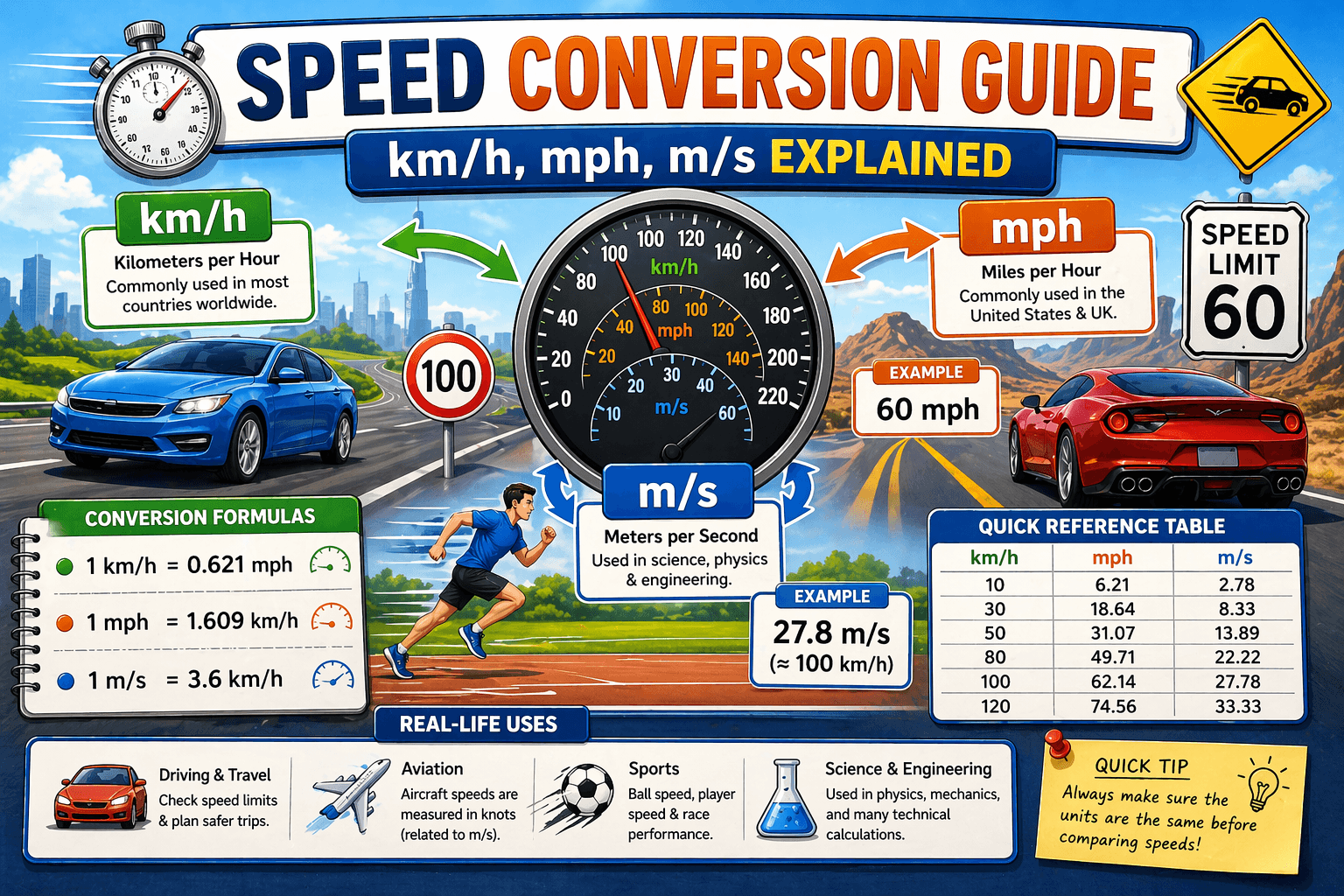
Speed conversion is something most people use without even realizing it. Whether you are checking speed limits while traveling, comparing vehicle performance, or studying motion in physics, different units like kilometers per hour (km/h), miles per hour (mph), and meters per second (m/s) are used across the world. These differences exist because countries follow different measurement systems. Understanding how these units relate to each other helps you interpret speed accurately and avoid confusion when switching between systems.
🚦 Think of Speed as “Distance Over Time”
Before jumping into conversions, understand this:
👉 Speed = Distance ÷ Time
- km/h → kilometers per hour
- mph → miles per hour
- m/s → meters per second
👉 Same concept, just different units.
🌍 Why Different Speed Units Exist
Speed units depend on the measurement system:
- km/h → Metric system (India, Europe)
- mph → Imperial system (USA, UK)
- m/s → Scientific calculations
👉 For example:
- Physics problems → m/s
- Road signs in India → km/h
- US highways → mph
👉 This is why speed signs look different across countries. Understanding these systems helps when comparing global measurement standards.
🔢 Key Conversion Values You Should Know
Instead of memorizing everything, focus on these key values:
- 1 km/h ≈ 0.621 mph
- 1 mph ≈ 1.609 km/h
- 1 m/s = 3.6 km/h
- 1 km/h ≈ 0.278 m/s
👉 These four conversions are enough for most cases. These values are derived from standardized measurement systems used worldwide.
🧠 A Smarter Way to Understand Speed Conversion
Instead of thinking in numbers, think in scale differences:
- km/h → larger distance unit
- m/s → smaller, more precise unit
👉 That’s why: 72 km/h = 20 m/s (smaller number)
🛣️ Real-Life Driving Examples
Let’s connect this to real situations:
- Highway speed: 100 km/h ≈ 62 mph
- City driving: 50 km/h ≈ 31 mph
- Fast runner: 10 m/s ≈ 36 km/h
👉 These examples make conversions easier to remember. Speed differences can often confuse travelers when driving abroad.
⚡ Quick Mental Conversion Tricks
You don’t always need exact math.
👉 Use these shortcuts:
- km/h → mph: Multiply by 0.6
- mph → km/h: Multiply by 1.6
- km/h → m/s: Divide by 3.6
👉 These are fast and practical. However, for precise calculations, always use accurate formulas.
🧪 Speed in Science vs Daily Life
Speed is used differently depending on context:
- Driving → km/h or mph
- Physics → m/s
- Aviation/Marine → knots
👉 Each field uses units suited to its needs. This variation shows how measurement systems adapt to different industries.
🛣️ Understanding Speed Through Real Situations
Let’s connect this to everyday life.
Imagine you’re driving:
- 60 km/h → normal city driving
- 100 km/h → highway speed
- 120 km/h → fast highway
Now convert:
- 60 km/h ≈ 37 mph
- 100 km/h ≈ 62 mph
- 120 km/h ≈ 75 mph
👉 This helps you instantly understand speed limits in different countries. It also highlights how important unit conversion is in everyday decision-making.
⚠️ Common Mistakes to Avoid
- Confusing km/h with m/s
- Using rough estimates for precise calculations
- Forgetting unit labels
👉 Always double-check before finalizing to avoid any unit confusion. These mistakes are common across many types of unit conversions.
📊 Speed Conversion Table (Quick Reference)
| km/h | mph | m/s |
|---|---|---|
| 30 | 18.6 | 8.33 |
| 50 | 31 | 13.89 |
| 80 | 49.7 | 22.22 |
| 100 | 62.1 | 27.78 |
🎯 Why Speed Conversion Matters
Understanding speed conversion helps you:
- Drive safely in different countries
- Understand vehicle specifications
- Learn physics concepts easily
- Compare speeds globally
👉 It’s a practical skill used more often than you realize.
✅ Conclusion
Speed conversion becomes simple once you understand the relationship between distance and time. By learning key conversion values and using quick mental tricks, you can easily switch between km/h, mph, and m/s in both daily life and technical situations.
🔗 Related Guides
📌 Key Takeaways
- Speed is distance divided by time.
- km/h, mph, and m/s are the most common speed units.
- 1 m/s equals 3.6 km/h.
- Quick tricks help estimate speed conversions easily.
- Speed conversion is useful in travel, driving, and science.